Stories don’t just happen. Behind them are journalists asking questions, finding answers and helping us understand the communities we call home.
REVEALS
The stories someone has to uncover.
A public official’s decision. A questionable expenditure. A problem affecting families that no one has adequately explained.
Local reporters ask questions, examine records and follow stories wherever the facts lead. Their work brings important information into the open and gives communities the knowledge to demand answers.
CPA AWARD-WINNING JOURNALISM
Aspen Journalism
The Aspen 80
Aspen Journalism matched property records with Forbes’ billionaire list to identify 80 billionaire owners with Pitkin County ties and examine the local concentration of wealth.
Head of Colorado’s guardianship office resigns amid reports of ‘toxic’ workplace, high turnover
Marianne Goodland examined staff complaints, turnover and agency records to show problems inside the state office responsible for adults with no one else to serve as guardian.
Crime doesn’t appear to increase; Are people reporting?
Regan Tuttle tested perceptions of rising crime against sheriff’s incident records, then asked what those figures miss when residents don’t report offenses.
What’s happening at your child’s school? Why are property taxes changing? Where is the wildfire spreading? What’s on the ballot?
Local news helps us understand the decisions, events and challenges that affect our families, businesses and communities. It’s information we can use.
CPA AWARD-WINNING JOURNALISM
Boulder Reporting Lab
Xcel plans power shutoff in Boulder on Dec. 17 amid extreme fire risk
Boulder Reporting Lab explained who could lose power, how residents could check their address and what families, schools and businesses needed to prepare.
Counselors confront Jeffco schools over mental health cuts
Suzie Glassman traced counselors’ questions about voter-approved funding and explained how cuts to district support teams could affect students and schools.
Colorado task force tackles aggressive and violent student behavior toward teachers
Melanie Asmar connected educators’ experiences with a statewide effort to improve safety, explaining proposed response teams, staff training and support after assaults.
Wildfire Sparks North of Buena Vista, Pre-Evacuation Orders Issued
On-scene updates tracked the Mountain View Fire, evacuation notices and service outages, while directing residents to official alerts and places to take animals.
The legacy and loss of Colorado’s once-mighty glaciers
Seth Boster combined scientists’ findings with Colorado’s glacial history to explain what shrinking ice means for familiar mountain landscapes, wildlife and people’s sense of place.
The restaurant opening down the street. The high school team headed to state. The neighbor doing something extraordinary. The festival that brings everyone together.
Local news helps us discover businesses, events, opportunities and people we might otherwise miss.
It reminds us that we’re part of something larger than ourselves.
CPA AWARD-WINNING JOURNALISM
The Southern Ute Drum
Native students get ‘Close Up’ in D.C.
Divine Windy Boy’s photo essay follows Southern Ute students to Washington, where they shared tribal-government knowledge and proposed stronger Native American curriculum in public schools.
Durango coder creates mysterious downtown scavenger hunt for locals, tourists
Elizabeth Pond followed a locally built scavenger hunt through downtown landmarks and businesses, introducing readers to a playful way to explore their city.
'Groundswell' of support for local farmers honors Casey Piscura's memory
Kaya Williams brought together farmers, family members and neighbors to explain how a Carbondale community was sustaining a local farm and expanding support for farmers after a shared loss.
On the rural Colorado plains, cancer patients with no local options rely on this traveling oncologist
Jennifer Brown followed a traveling cancer-care team to Lamar and Trinidad, connecting rural patients’ daily lives with the doctors and local hospitals helping them get treatment close to home.
Descendants of the storied 10th Mountain Division, trained in Colorado mountains, relive their ascent of Riva Ridge
Stina Sieg accompanied descendants of Colorado-trained soldiers back to Italy, bringing family memories and the 10th Mountain Division’s history together as they retraced a wartime climb.
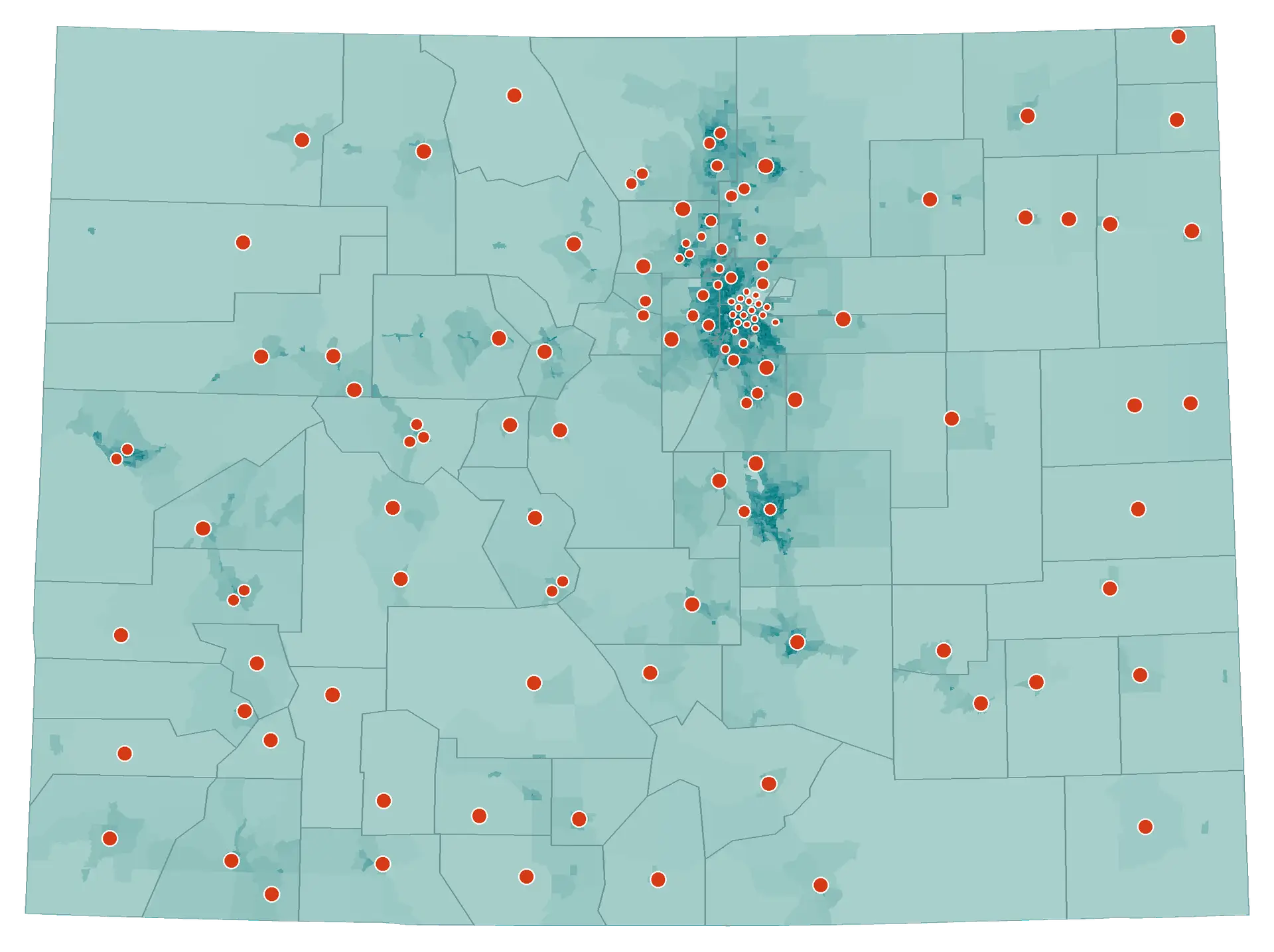
The reporting that informs your decisions, holds institutions accountable and connects your community is happening in newsrooms across Colorado. Find the outlets covering where you live.
Local journalism helps communities understand what's happening, make decisions, build connections and hold institutions accountable. Research shows what that work contributes and what communities risk losing without it.
01 / INFORMATION
Know what's happening when it matters.
From school decisions and public meetings to severe weather and emergencies, local reporting provides information people use to navigate daily life.
80%
of surveyed Coloradans rated state and local media's emergency information good or
excellent.
68% of U.S. adults said local news media do well at covering the most important stories and issues in their
area.
02 / CONNECTION
A community that knows itself.
Local news helps people recognize shared concerns, celebrate achievements and understand the places and people around them.
75%
of U.S. adults said they had a lot or some trust in information from local news
organizations.
79% of Colorado newspaper readers said they felt responsible for helping shape their community's
future.
03 / LOCAL ECONOMY
Local news helps local businesses thrive.
Newsrooms connect customers with businesses, cover local economic developments and provide advertising environments rooted in their communities.
7 in 10
of Colorado newspaper readers say they took action after seeing a newspaper
ad.
55% of Colorado adults said newspaper advertising helped them decide what to buy or where to shop, more than any other channel
listed.
04 / ACCOUNTABILITY
Someone needs to ask the questions.
Journalists examine public decisions, scrutinize spending and uncover information that might otherwise remain hidden.
29%
lower toxic emissions at consumer-goods plants after newspaper coverage, compared with plants that were not covered, in one
study.
93% of Colorado adults said press and public access to public records was
important.
WHEN LOCAL NEWS DISAPPEARS
The consequences reach beyond the newsroom.
01 / PUBLIC COSTS
Losing a newspaper can cost taxpayers.
Public borrowing costs rose. Research found local governments paid more to borrow after their newspapers closed, costs that fall on
taxpayers.
Corruption cases rose. Federal corruption cases rose about 7% in districts that lost a major daily
newspaper.
02 / CIVIC LIFE
Fewer people take part.
Civic engagement dropped. After the Rocky Mountain News closed in 2009, civic engagement in Denver dropped, while comparable cities that kept their newspapers saw no similar
decline.
Fewer voters and candidates. After the Cincinnati Post closed, researchers found lower voter turnout and fewer municipal candidates in the Kentucky communities that had relied on it
most.
03 / LOCAL ECONOMY
Local brands lose a connection.
Local brands lost revenue. A study of regional consumer brands linked local newspaper closures to an average 7.8% decline in weekly
revenue.
Businesses paid more to borrow. After a nearby newspaper closed, corporate loan rates rose about 0.3 percentage points—roughly $1.2 million in extra interest on the study’s average
Colorado Media Project's 2022 statewide survey found that 80% of respondents rated state and local media's emergency information good or excellent.
Corona Insights surveyed more than 1,800 Colorado residents in summer 2022. This is a rating of state and local media, not a measured emergency outcome or newspaper-only result.
Pew Research Center found that 75% of U.S. adults said they had a lot of or some trust in information from local news organizations, up 5 points from a year earlier.
The American Trends Panel survey included 5,193 U.S. adults and was conducted September 14–20, 2026. Published November 2, 2026. These are national findings, not Colorado-only results.
Colorado readers, newspaper advertising and public records
The Colorado Local News Market Study reports that 79% of Colorado newspaper readers felt responsible for helping shape their community's future. It also reports 93% of Colorado adults considered press and public access to public records important.
The report describes nearly 7 in 10 readers taking action after reading a print or digital newspaper advertisement. Actions were self-reported, not a measured advertising lift or sales-conversion rate. The same report found that 55% of Colorado adults said newspaper advertising helped them decide what to buy or where to shop, more than any other channel listed.
CPA commissioned the 2022 report from Coda Ventures. Its online survey included 601 Colorado adults and was fielded November 30–December 14, 2021. Reader attitudes and all-adult findings have different bases.
Pamela Campa’s 2018 study, Press and leaks: Do newspapers reduce toxic emissions?, found that consumer-goods producers reduced toxic emissions by 29% following newspaper coverage, compared with plants that were not covered.
The finding uses U.S. plant-level data from 1996–2009. It concerns the consumer-goods subgroup and an observational event-study comparison, not every factory or pollutant.
Lee Shaker’s Dead Newspapers and Citizens’ Civic Engagement examined civic engagement in Denver and Seattle around their 2009 newspaper losses and compared the changes with other metropolitan areas.
The 2014 study found significant short-term declines in the two affected cities. It used 2008 and 2009 civic-engagement data; Seattle’s Post-Intelligencer ended print publication but continued online.
Gao, Lee and Murphy’s Financing Dies in Darkness: The Impact of Newspaper Closures on Public Finance was published in the Journal of Financial Economics in 2020.
The study compared municipal borrowing around newspaper closures with other counties. Higher public borrowing costs represent a fiscal cost to communities, not a forecast of an individual household’s tax bill.
Ted Matherly and Brad N. Greenwood, “No News is Bad News: The Internet, Corruption, and the Decline of the Fourth Estate,” MIS Quarterly 48(2), 2024, pp. 699–714. DOI: 10.25300/MISQ/2023/17869.
The study found 7.3% more federal corruption cases filed in districts that lost a major daily newspaper. Read the authors’ explanation ↗
Zhiming Ma, Derrald Stice, Han Stice and Yue Zhang, “Local newspaper closures and bank loan contracts,” Contemporary Accounting Research 42(3), 2025, pp. 1620–1651. First published April 28, 2025.
The study found syndicated corporate loan spreads rose by 30.24 basis points after a nearby newspaper closed. For the study’s average $119 million loan over 40 months, that amounts to roughly $1.2 million in additional interest.
After the Cincinnati Post closed, researchers found lower voter turnout and fewer municipal candidates in the Kentucky communities that had relied on it most.
This source concerns the Cincinnati Post and its Kentucky communities. It is separate from the Denver and Seattle civic-engagement study.
Local news is part of your community. Be part of its future.
Behind every local story are people asking questions, finding answers and helping their neighbors understand the world around them. You can help keep that work going.